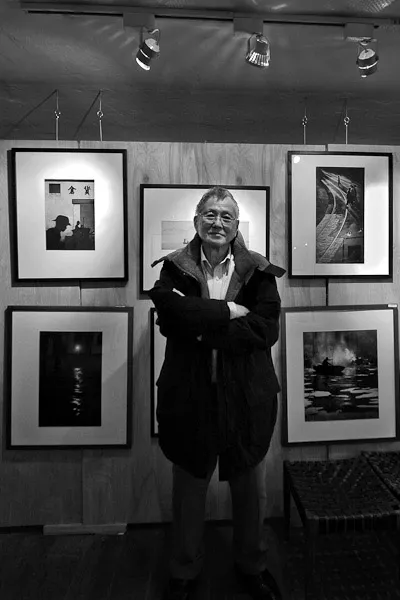
Fan Ho
10/11/2022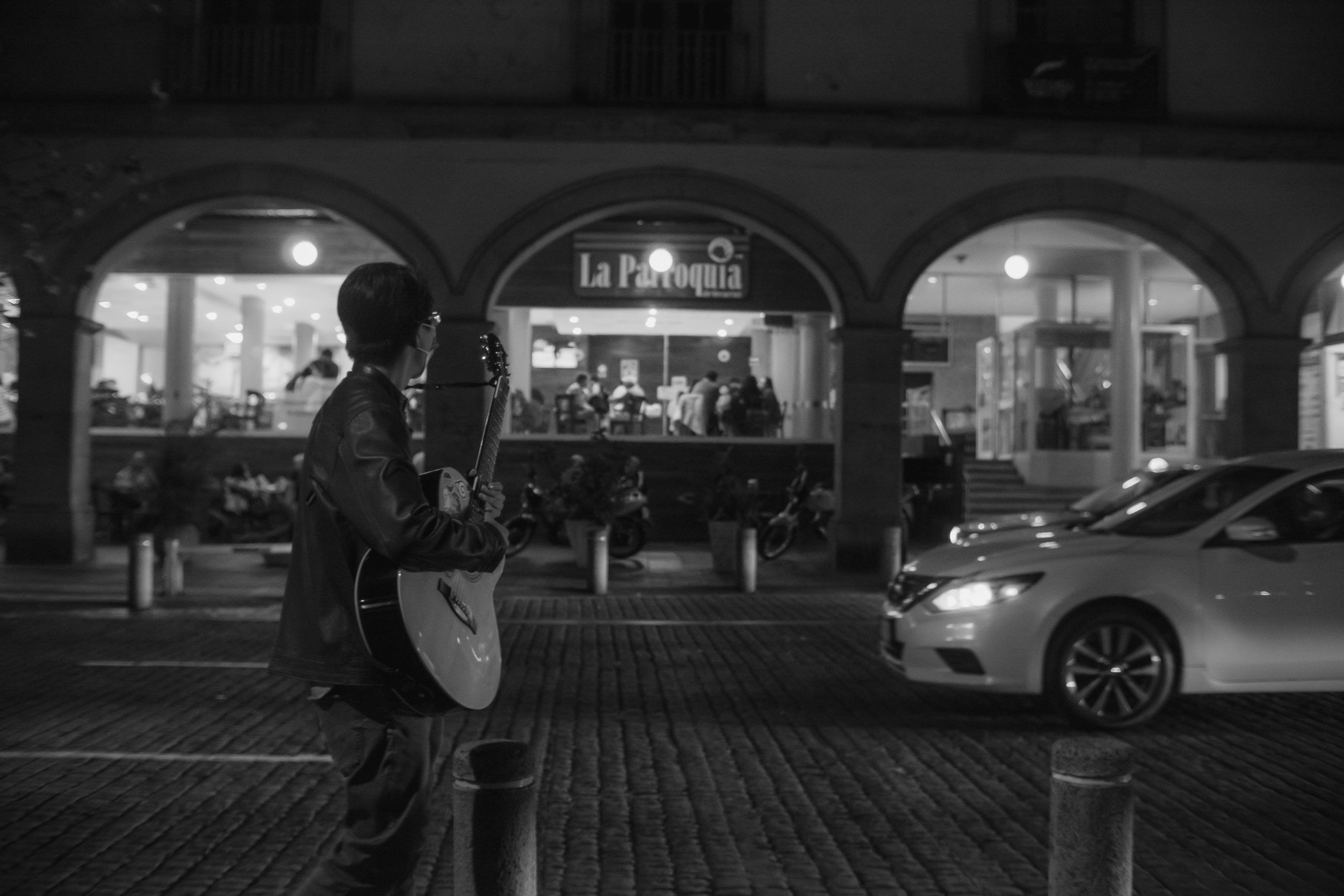
Xalapa Monochromatic
13/11/2022It is the eternal question. But surely before trying to answer it, there are a few more questions to be asked.
Is this a pertinent question? I would say yes: it is in our interest to be aware of when and why we choose one option over the other.
Is it an exclusionary decision? That is, should we make Street photography exclusively in black and white or in color? I don't see why.
But...
I also believe that a gallery (or Instagram profile) should separate or at a minimum group monochrome and color images.
A difficult coexistence
I refuse to state categorically that you can't just combine black and white and full color photos in a way that visually works well. But only because I don't like to be dogmatic: the truth is that I don't remember having seen any portfolio that mixes both types of images without a minimum order that made a good impression on me.
If you know of any, please share them in the comments, I can't wait to change my mind!
Whenever I have found attractive galleries with color and black and white photos there has always been grouping, breaking up or some kind of separation.

The eye needs to adapt and we need to understand that images read differently, and that requires pause.
A period, at the very least.
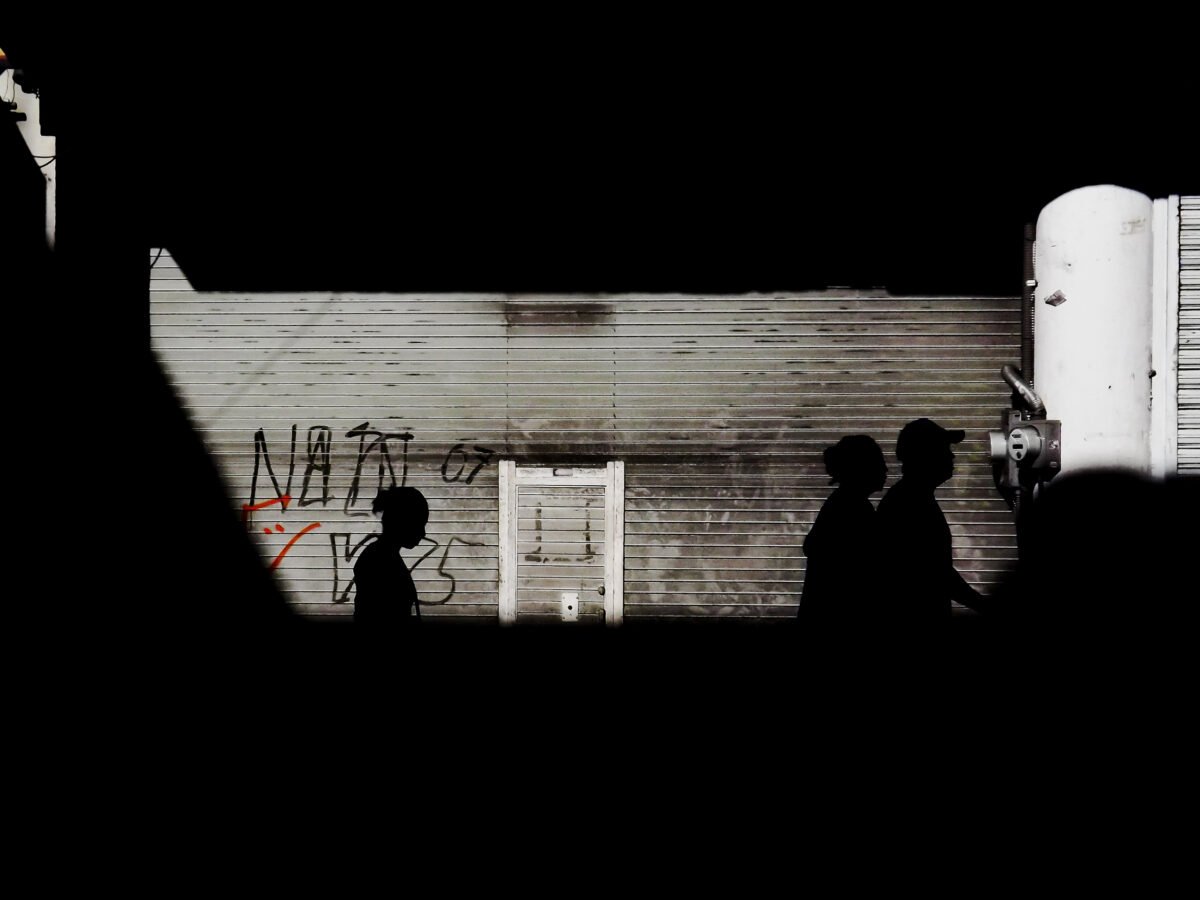
The trick with black-and-white (street) photography
Do we like a black and white image because it is a good image or are we predisposed to like it precisely because it is in black and white?
Yeah, I know, defining what is a good photograph is not easy, but that's not the discussion here....
Black and white came before because film did not have the capacity to record color images, so the black and white we revere was actually born as a limitation of the process. Thus, the black and white we revere was actually born as a limitation of the process. Do you think that if film had been able to capture color from the beginning we would still have monochrome photography? Possibly not.
But the great names in history - those who laid the foundations of the street photography - photographed in black and white (some throughout their careers) and that weighs. It weighs a lot.
Because, who has not started in this world wanting to photograph as did Henri Cartier-Bresson, Garry Winogrand o Vivian Maier(By the way, the last two also photographed in color, although these images have hardly transcended).
It is not easy to photograph as Bresson o Maier, But we can always convert our images to black and white and at least they will have a similarity... Something is something.
That's the trick to black and white street photography (which, of course, is not unique to the genre): often, simply because an image lacks color, we are willing to look at it with different eyes., After all, it's not so different from some of the best known (and recognized) in history, is it?
Only superficially.
Which is easier?
Let's make one thing clear: taking good photos is hard. Always.
Is it easier to photograph in color or in black and white? At the risk of being tiresome: it is never easy. However, if we ask ourselves if one option is less difficult than the other, we have to start from the fact that taking black and white photos is much more than simply converting our images to grayscale in the digital development program or buying black and white film.
Color and black and white photos are taken differently and work differently.
Those who master the black and white street photography are able to anticipate what the monochrome image will look like before they even press the shutter button. They know what gray a certain green, red, yellow is going to turn into... They read light differently than those of us who shoot in color because they are looking for different things.
By the way...
Photographing in color or photographing color?
Photographing in color means choosing to show our images as we see reality (or at least in a more similar way), having information that black and white photos lack. Although color is of course much more than just visual information (it has psychological implications, it works differently on its own than in combination with others, etc.), shooting in color rather than black and white only means choosing one of two possibilities.
Photographing color, on the other hand, means considering it as one more variable to be taken into account, another factor in the equation. It is not the same to photograph a scene showing color as it is to take an image - to a greater or lesser extent - precisely because of the color it contains.

When I see a mass of color my ears stiffen; I know that the success of any photograph I make, regardless of the subject I'm working on, is going to depend on how I use that color in the construction of the image.
Cristobal Hara
A mass of color can justify a capture by itself, that is its strength. At the same time an element of color can ruin a photograph, that is its double edge.
If it's going to be black and white, make it yours.
If you do Street photography Can you set your camera to view the scene in monochrome through the viewfinder or screen and does that help? Go ahead, but be sure to shoot in RAW to preserve all the scene information, color included.
Why should you keep the color of a scene that you want to show in black and white? (It seems that this post has more questions than answers, but I think I haven't left any unanswered...). To control the look of the final image.
If you let the camera convert the scene to black and white it will make a series of decisions that could be in your hands. Editing programs such as Adobe Lightroom (to give as an example the one I usually use) allow you to control what gray each color in the scene ends up becoming.
As if that were not enough, from a RAW photograph you can take an infinite number of different images, all of them in black and white, just by changing the settings in the corresponding panel.


After all, if you are going to show the world as it is not, why should you accept the camera's interpretation?
In addition, you can always take the RAW file, apply a preset and keep both the original file and a “quick” black and white version.
In short
I advise you to choose to photograph in color or to photograph in black and white. I can't and won't try to convince you to choose one of the two possibilities, although I will tell you why I chose color (by default).
My mental process when looking at a photograph (which I had not made thinking in color or black and white, I had just been shooting) was more or less this:
- Mmm... This photo is missing something.
(Of course, it lacked things: intention, criteria, time working on the scene... etc.).
- What if I try switching it to black and white? Aha. Look at that. It's not so bad.
In other words: I was cheating. By turning the photos to grays, I was also lowering my standards. Something very normal, on the other hand, we all want our photos to please us. At first we even want the bad ones to do so, after all, they are ours.
So I chose to shoot in color (yes, I'm still learning to shoot color, and that was a few years ago), but I could have also chosen to shoot in black and white consciously, that is, making an effort to compose thinking about the final appearance of the image once converted.

My advice is to choose one, the one that you like, motivates or challenges you the most and make it your goal to get the most out of it. If it's color, force yourself to learn to photograph color, if it's black and white force yourself to learn to see without color. By specializing you will improve your skills.
It's not a forever decision, you can experiment with the other way as many times as you want. It's good for all of us to get out of our comfort zone, although I prefer the way Alfonso Alcántara sees it:
Don't go out of your comfort zone, make it bigger.
Yoriento.
But make sure you photograph in a conscious way, if you do color, think about it, if you opt for black and white, be careful and make sure that this aspect is not the only thing that saves the result.
Oh, don't forget to take care of the mixture.
And, above all, have fun.
NOTE BY: JOTA BARROS at: https://jotabarros.com/fotografia-callejera-blanco-negro-color/

 Spanish
 English
 Portuguese